


Minneapolis is burning with grief and fury — and the rest of the country shouldn’t look away. Over the past several weeks, federal immigration enforcement operations have left at least two U.S. citizens dead at the hands of ICE and U.S. Border Patrol agents. Renee Nicole Good, a 37-year-old mother of three, was shot and killed on January 7 in broad daylight during an ICE operation. Alex Jeffrey Pretti, a 37-year-old ICU nurse known for his devotion to veterans, was shot and killed on January 24 — again by federal agents amid immigration enforcement activity. Both deaths sparked shock, protests, and national outrage.
In both cases, Federal officials rushed out a narrative labeling these citizens “threats” or “domestic terrorists,” but videos circulating online — from multiple angles — undercut those claims, showing Pretti holding only a phone and aiding others when he was gunned down.
There are few things more morally bankrupt than scrolling past the deaths of Renee Good and Alex Pretti and seeing people shrug — or worse, sneer — that they somehow “deserved” what happened to them because they were protesting.
Let’s be absolutely clear: peaceful protest is not reckless behavior. It is not provocation. It is not an invitation for state violence. It is a constitutional right — and more than that, it is the single most reliable engine of progress this country has ever had.
The idea that peaceful protest is now viewed by many Americans as a “dangerous activity” — something you do at your own peril — should terrify anyone who claims to love freedom. Because if protest becomes punishable by death, democracy is already on life support.
And history proves this, over and over again.
Protest Isn’t a Glitch in the System — It Is the System
The First Amendment doesn’t protect speech and assembly because they’re convenient. It protects them precisely because they make people in power uncomfortable.
Nearly every right we now treat as normal — even take for granted — was once radical. And nearly every one of those rights was won because ordinary people refused to sit down and be quiet.
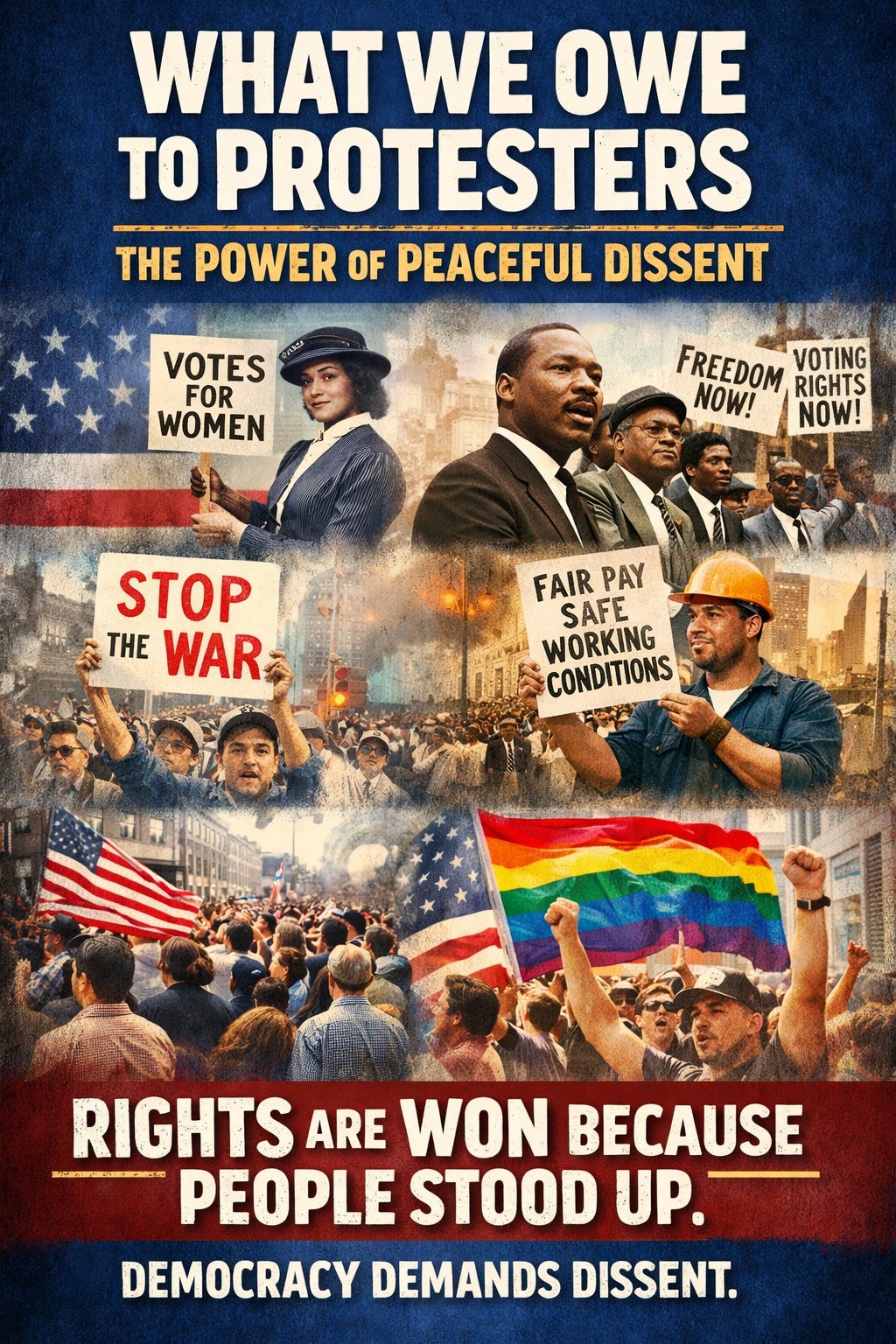
Women’s Suffrage: Democracy Didn’t Expand Itself
For most of American history, women had no political voice. They didn’t gain the vote because lawmakers woke up enlightened one morning. They marched. They organized. They were arrested. They endured mockery, violence, and public scorn.
Their peaceful protests forced the nation to confront an obvious injustice — and resulted in the 19th Amendment. Half the population gained a voice precisely because they demanded it, and they would not sit down and be quiet.
Slavery, Civil Rights, and Voting Rights: Progress Demanded, Not Granted
The abolition of slavery was not a polite negotiation. For fuck sake we fought a Civil War over it. But the catalyst was driven by abolitionists who refused to sit down and be quiet, who organized, published, marched, and forced the country to look at its own brutality.
A century later, the Civil Rights Movement followed the same blueprint. Sit-ins. Marches. Boycotts. Nonviolent resistance in the face of state-sanctioned brutality led by Dr. Martin Luther King, Jr, Rosa Parks, John Lewis, A. Phillip Randolph, Roy Wilkins, the Freedom Riders, and so many others.
Those protests led directly to the Civil Rights Act and the Voting Rights Act — two of the most important pieces of legislation in American history. Without protest, segregation would not have ended when it did. Without protest, Black Americans would not have secured federal protections for basic citizenship.
Labor Rights: The Weekend Was Protested Into Existence
The eight-hour workday. The 40-hour work week. Overtime Pay. Workplace health and safety laws. Child labor protections. The right to organize.
None of these came from corporate generosity. They came from workers standing together — often facing violence — and demanding dignity. The modern workplace exists because people were willing to protest conditions that treated human beings as expendable.
The Vietnam War: When Protest Forced Power to Listen
If anyone doubts that peaceful protest can change national policy, they should look no further than the Vietnam War.
The war didn’t end because leaders suddenly found their conscience. It ended because millions of Americans refused to sit down and stay silent.
Students walked out of classrooms. Veterans threw their medals onto the steps of the Capitol. Clergy marched beside college kids. Mothers protested because their sons were being drafted. Journalists amplified voices Washington wanted ignored.
The anti-war movement was massive, sustained, and overwhelmingly peaceful. And it worked.
Public protest exposed lies used to justify escalation. It shifted public opinion. It pressured Congress. It forced accountability. In the end, the Pentagon Papers confirmed what protesters had been saying all along: the government knew the war was unwinnable — and kept going anyway.
The result?
• U.S. troop withdrawals
• An end to the draft
• Limits on presidential war powers
• A permanent shift in how Americans view military intervention
Peaceful protest didn’t just change minds — it saved lives.
And just like today, protesters were smeared as traitors, radicals, and enemies of the state.
History vindicated them.
LGBTQ Rights: Visibility Was a Form of Protest
LGBTQ Americans didn’t gain rights by waiting quietly to be accepted. They protested invisibility itself.
From the Stonewall uprising to Pride marches across the country, peaceful protest forced a nation to see people it preferred to ignore. That visibility led to anti-discrimination protections, marriage equality, and cultural shifts that saved countless lives.
Every advance was resisted. Every protest was criticized. And every one of them mattered.
Why Peaceful Protest Must Be Protected — Especially Now
What we are seeing today is not a failure of protest — it’s a failure of power to tolerate dissent and a failure of many citizens to understand where most of the freedoms they take for granted today came from.
When peaceful protesters are framed as threats, when federal agents respond to citizens with lethal force, when accountability is dodged, and narratives are rushed out before investigations — democracy is in danger.
Protest is not violence. Protest is not chaos. Protest is not un-American. In fact, protest is among the most patriotic activities a US citizen can take part in. Protest is how a free society corrects itself.
So while so many go about their little entitled lives enjoying the fruits of so many people’s sacrifices, you should stop and ponder for a moment on this…If you believe peaceful protest should be “dangerous,” you are not defending order — you are endorsing authoritarianism.
The right to protest is the pressure valve that keeps democracy from exploding. Remove it, and what follows is not peace — it’s fear.
We owe it to Renee Good, Alex Pretti, and every person who has ever marched, sat-in, spoken out, or held a sign — to defend peaceful protest not as a nuisance, but as a moral necessity.
Because the moment we decide dissent deserves punishment is the moment we stop being free. Protest works. That’s why it’s under attack.

Thank you for organizing this so succinctly!